The Coral Triangle’s Best-Kept Secret
Raja Ampat gets the magazine covers, the Instagram algorithms, and the liveaboard waitlists stretching six months out. But roughly 1,200 kilometers to the northwest, tucked inside the Gulf of Tomini off Central Sulawesi, the Togean Islands are doing something quietly extraordinary: growing some of the most biodiverse reef systems in the Coral Triangle without the crowds, without the price tags, and without the performance of it all. Most travelers who end up there stumble in by accident, having heard a rumor from another diver on a bus to Ampana. That word-of-mouth pipeline has kept the Togeans deliberately slow, deliberately odd, and entirely themselves.
The archipelago spans around 56 islands and hundreds of smaller islets and sandbars across protected national park waters. What makes it genuinely unusual is that it contains three distinct reef types – atoll, barrier, and fringing – within a single, compact geographic area. For a coral wanderer, that ecological range is almost absurd in its generosity. You can snorkel a shallow patch reef at 9 a.m. and be drifting over a deep wall by noon, without ever boarding a liveaboard.
What the Reefs Actually Look Like
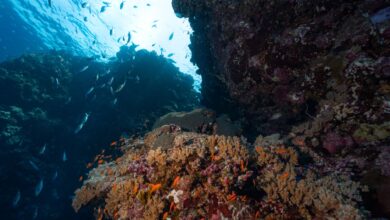
The Togean reefs did not escape the bleaching events that struck much of Southeast Asia, but their recovery rate has impressed marine researchers working in the region. The relative isolation, combined with lower boat traffic and minimal runoff from agriculture, has given the coral enough breathing room to rebuild. Staghorn formations that would look at home in a natural history exhibit rise from shallow sandy floors. Massive brain corals – some estimated to be centuries old – anchor the deeper sections of the barrier reef like natural monuments nobody bothered to name.
Fish life runs thick. Bumphead parrotfish move through the shallows in schools large enough to hear before you see them, their teeth scraping coral producing a sound that carries underwater like distant applause. Reef sharks circle lazily at cleaning stations near Una Una Island, a volcanic island whose crater sits 507 meters above sea level and whose underwater flanks drop sharply into cobalt-blue water. Turtles are so common here they barely register as a sighting – they rest on the surface between dives, gulping air beside snorkelers who forgot to be amazed. The Togeans also have one of the few accessible populations of Tomini clownfish, a species found only in the Gulf of Tomini, making it a genuine endemic draw for underwater photographers who know what they’re looking for.
Jellyfish Lake on Kadidiri Island deserves its own mention. A landlocked saltwater lake, separated from the open sea long enough that its jellyfish population – predominantly golden jellyfish and moon jellyfish – evolved without predators and consequently lost their sting. Swimming through a dense pulse of warm, translucent jellyfish is one of those experiences that sounds gimmicky in description and turns out to be genuinely disorienting in the best possible sense. The lake sits a short hike through jungle from the beach. There are no crowds at the trailhead.
Above the water, the Togeans are not trying to impress anyone. The main islands have a handful of basic guesthouses, some built on stilts over the water, run mostly by local families who have been hosting divers since the late 1990s. There are no international resort chains here, no beach clubs, no structured excursion packages with laminated menus. Electricity runs on generators that cut out at midnight. That absence of polish is either the whole point or a dealbreaker, depending on who you are.

Getting There Is Part of the Deal
Access to the Togeans is genuinely inconvenient, and that inconvenience is almost certainly why they remain as intact as they are. The most common overland route involves flying into Palu or Luwuk, then taking a combination of buses and public ferries to reach the port town of Ampana or Gorontalo, depending on which end of the archipelago you’re targeting. The ferry crossings themselves are slow, operated on schedules that treat time as a suggestion. Total journey time from Bali or Jakarta, depending on connections, can run anywhere from 18 to 30 hours.
That friction filters the visitor pool aggressively. The Togeans attract divers who have already done Komodo and Bunaken and are actively seeking something with less infrastructure. They attract budget travelers comfortable with cold-bucket showers and squid-based dinner menus. They attract a specific kind of slow traveler who stays two weeks when they meant to stay five days, because there is nothing pressuring them to leave and the snorkeling outside the guesthouse is still producing new species on day nine. What the Togeans almost never attract is someone on a tightly scheduled week-long holiday, and the reef ecosystems benefit directly from that fact.
Honest Comparisons and What You Give Up
Raja Ampat’s visibility, marine biomass at depth, and sheer scale of manta ray and whale shark encounters are still genuinely difficult to match. The Togeans are not Raja Ampat. The liveaboard infrastructure doesn’t exist here, which means divers are mostly limited to day trips from island guesthouses, and deeper technical diving is not well supported. A handful of dive operators on Kadidiri and Wakai offer basic equipment rental and guided dives, but the level of professionalism varies, and gear inspection before any dive is non-negotiable.
What the Togeans offer instead is a reef experience that still feels like the early 2000s version of Indonesian diving – before the Instagram infrastructure, before the daily liveaboard queues, before the entrance fee gates and the boat traffic. The water clarity in the dry season, roughly April through October, regularly exceeds 25 meters on sheltered reef sections. The snorkeling directly off guesthouse docks, without any boat required, produces encounters that visitors at managed dive sites would pay significant money to replicate.

There is also the question of the Bajo people, the sea nomads who have lived on and around the Togean Islands for generations, building stilt villages over the reef flat and maintaining a relationship with the marine environment that predates the national park designation. Some have settled more permanently on Papan Island and other shallow-water platforms. Visiting those communities without a local guide is possible but tactless – going with someone who can make an introduction properly changes the experience entirely, and several local guesthouse owners run informal cultural visits as part of their offerings. The diving is the obvious draw, but the Togeans are not only a diving destination, and treating them as exclusively one sells the place short.