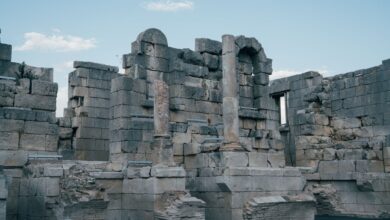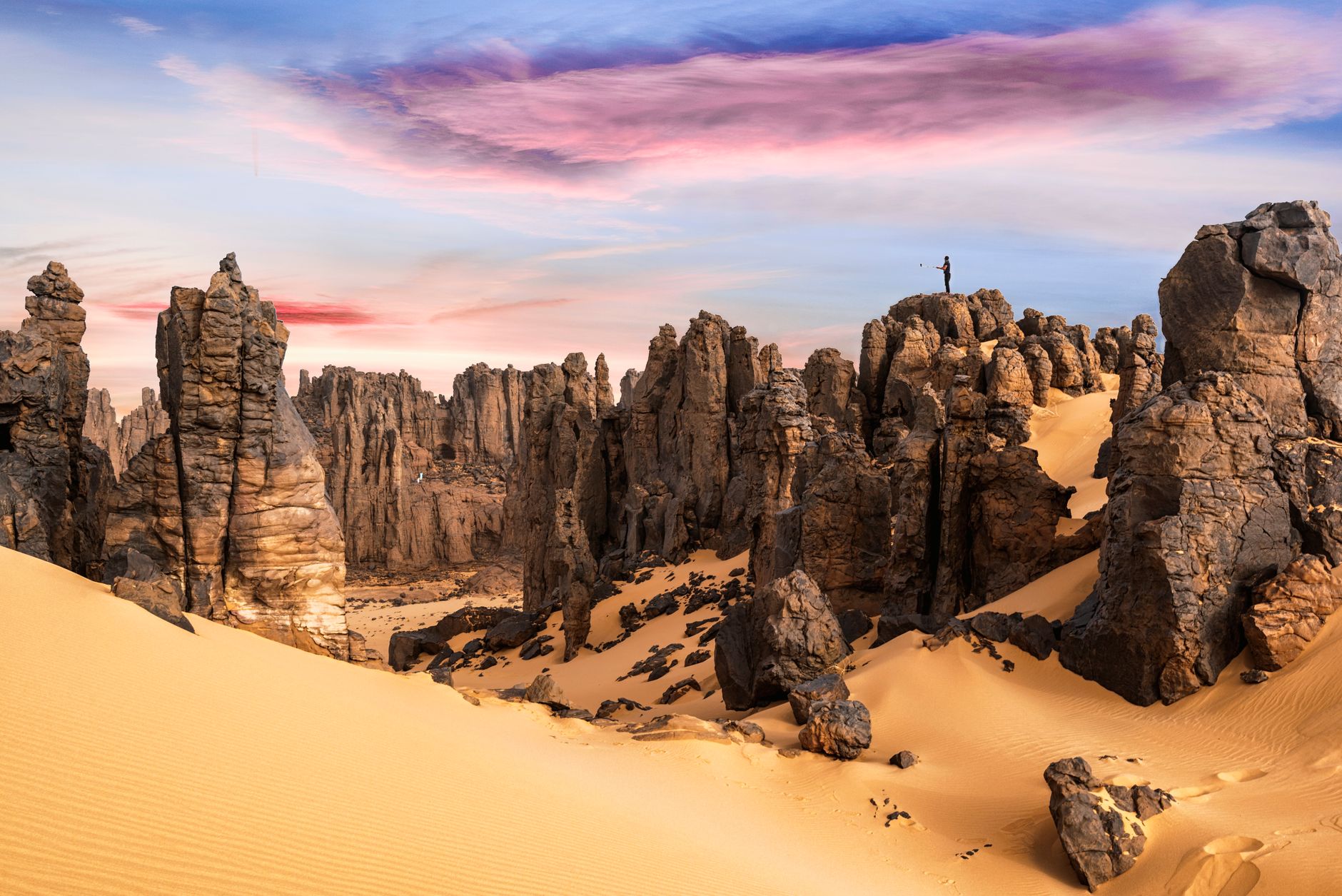

Tucked into the southeastern corner of Algeria, the Tassili n’Ajjer plateau holds more than 15,000 rock engravings and cave paintings spanning roughly 12,000 years of human history – making it, by sheer volume and age, one of the most staggering open-air archives on the planet. Yet while Petra fills flights and headlines, Tassili n’Ajjer receives a fraction of the visitors, a fraction of the coverage, and almost none of the mainstream travel conversation it deserves.
A Plateau That Rewrites Prehistory
The Tassili n’Ajjer range sits in the central Sahara, a labyrinth of eroded sandstone cylinders and arches rising above a landscape that was once savanna, riverine forest, and open grassland. The paintings and engravings left here document that vanished world in extraordinary detail – cattle herds, hippopotamuses, crocodiles, human figures in elaborate ceremonial dress, and domestic scenes that belong to a green Sahara that dried out several thousand years ago. The images are not abstract symbols. They are records.
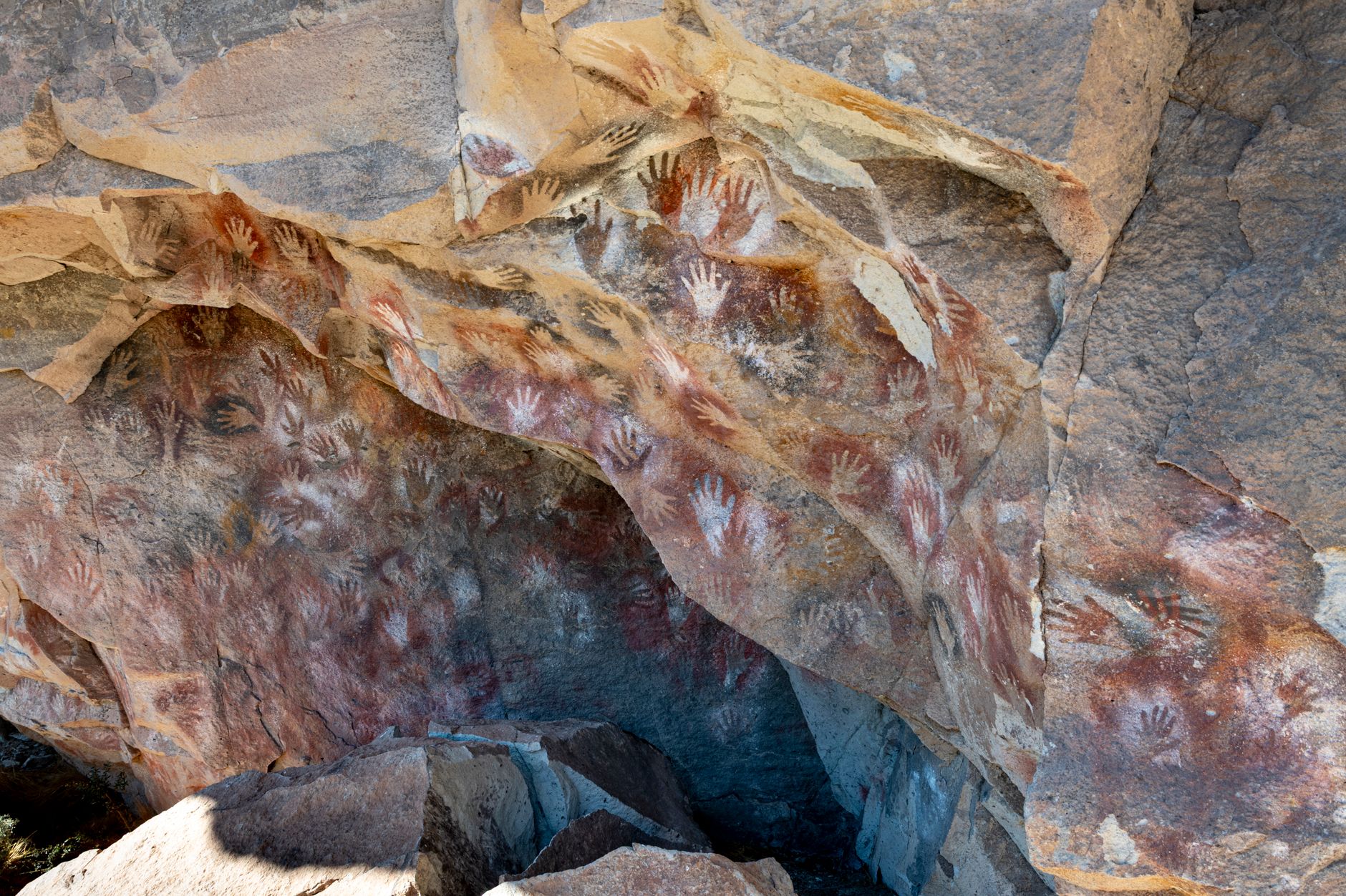
The oldest works in the region are attributed to what researchers call the Bubaline period, depicting giant buffalo now long extinct, followed by the Round Head period, which produced some of the most hauntingly strange figures in prehistoric art – large-headed, faceless forms that look almost extraterrestrial in their composition. Later came the Bovidian period, which offers the most detailed and lifelike imagery, including painted cattle with carefully rendered spotted hides and herders that seem to carry specific identities. Each period sits on top of or beside the last, creating a layered visual timeline that no museum could replicate.
Visiting Petra offers archaeology with infrastructure: signage, ticketing, a tourism economy built over decades. Tassili n’Ajjer offers something harder to access and harder to forget. Getting to Djanet, the nearest town and gateway to the park, typically involves a flight from Algiers or Tamanrasset, followed by arrangements with certified local guides – mandatory by law and, practically speaking, by necessity. The plateau itself is not a site you walk into unprepared. It is a wilderness that happens to contain art.
The UNESCO World Heritage designation arrived in 1982, covering the park’s combination of geological formations and cultural heritage. That designation did not bring mass tourism. The combination of Algeria’s complex visa requirements for many Western passport holders, limited direct international flights, and the logistical demands of desert travel has kept visitor numbers low enough that some of the most significant painted shelters see fewer than a few hundred visitors per year.
What Rock Art Travelers Actually Find Here
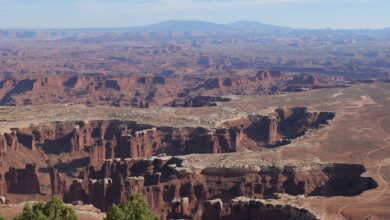
The experience of moving through Tassili n’Ajjer is defined by scale and silence. The sandstone formations known locally as a “forest of rocks” create narrow passages, sudden open plateaus, and the kind of disorientation that reminds you exactly how small you are. The art appears in this context not as a tourist attraction but as something continuous with the place itself – painted ceilings in shallow overhangs, engraved faces on boulders at eye level, images you almost walk past before they come into focus.
The site of Sefar is widely considered the most concentrated area of paintings within the park, containing thousands of images within a relatively compact section of the plateau. Guides lead visitors through it over the course of a full day’s walk, stopping at shelters where painted figures in ochre, white, and charcoal still hold their color despite the millennia. The preservation here is not because of climate-controlled conservation – it is because the desert is dry, the overhangs provide shade, and the site has remained largely undisturbed. That last condition is increasingly fragile as access improves.
Tadrart, a region within the broader Tassili area that extends toward the Libyan border, draws travelers specifically for its combination of dune landscapes and engraved rock panels. The colors of Tadrart’s sandstone – deep orange, red, and purple depending on the light – create conditions where ancient engravings almost glow against the rock face at certain hours of the morning. Photographers who have been to both Wadi Rum and Tassili consistently describe Tadrart as more visually complex, though far more difficult to reach.
Accommodation options near the park range from basic guesthouses in Djanet to tented desert camps run by local operators. Neither is luxurious, and that is part of the point. The absence of large resort infrastructure keeps the journey feeling proportionate to the destination – you do not arrive at a swimming pool after looking at 8,000-year-old paintings. The itinerary structure typically runs between five and ten days for a serious visit, with multi-day trekking on the plateau itself requiring camping gear and food supplies carried by the group.
Timing matters more here than at almost any other heritage destination. The summer months bring temperatures that make plateau trekking genuinely dangerous, with midday heat in July and August reaching levels that can cause rapid dehydration even with adequate water. The best window runs from October through March, when daytime temperatures are manageable, nighttime skies are some of the clearest in the northern hemisphere, and the low-angle winter light hits the rock faces in ways that make the engraved lines visible from distances that summer light would flatten entirely.
The Access Question and What It Protects
Algeria has been making deliberate moves to open its tourism sector over the past several years, simplifying visa processes for some nationalities and investing in domestic air connections to southern hubs like Djanet and Tamanrasset. Those changes have not yet produced a surge in arrivals, but travel operators who specialize in Saharan destinations report growing inquiry from travelers who have already done Petra, Wadi Rum, and Morocco’s southern routes and are looking for something that feels less visited. Tassili n’Ajjer answers that question almost too well.
The mandatory guide requirement, often cited as a barrier, functions in practice as the site’s most effective conservation mechanism. Without independent access, visitors cannot wander off route, touch surfaces, or camp near the most sensitive painted shelters. The debate among heritage specialists is whether increasing access – even managed access – will eventually produce the same gradual deterioration that has affected other major rock art sites globally, where breath, humidity, and physical contact slowly erode pigment that survived untouched for thousands of years. That tension has no clean resolution, and Algeria has not yet had to face it at scale. Whether it can maintain the balance when visitor numbers inevitably climb is the question the plateau itself cannot answer.